Module / TGATE
Temporal Gatekeeping
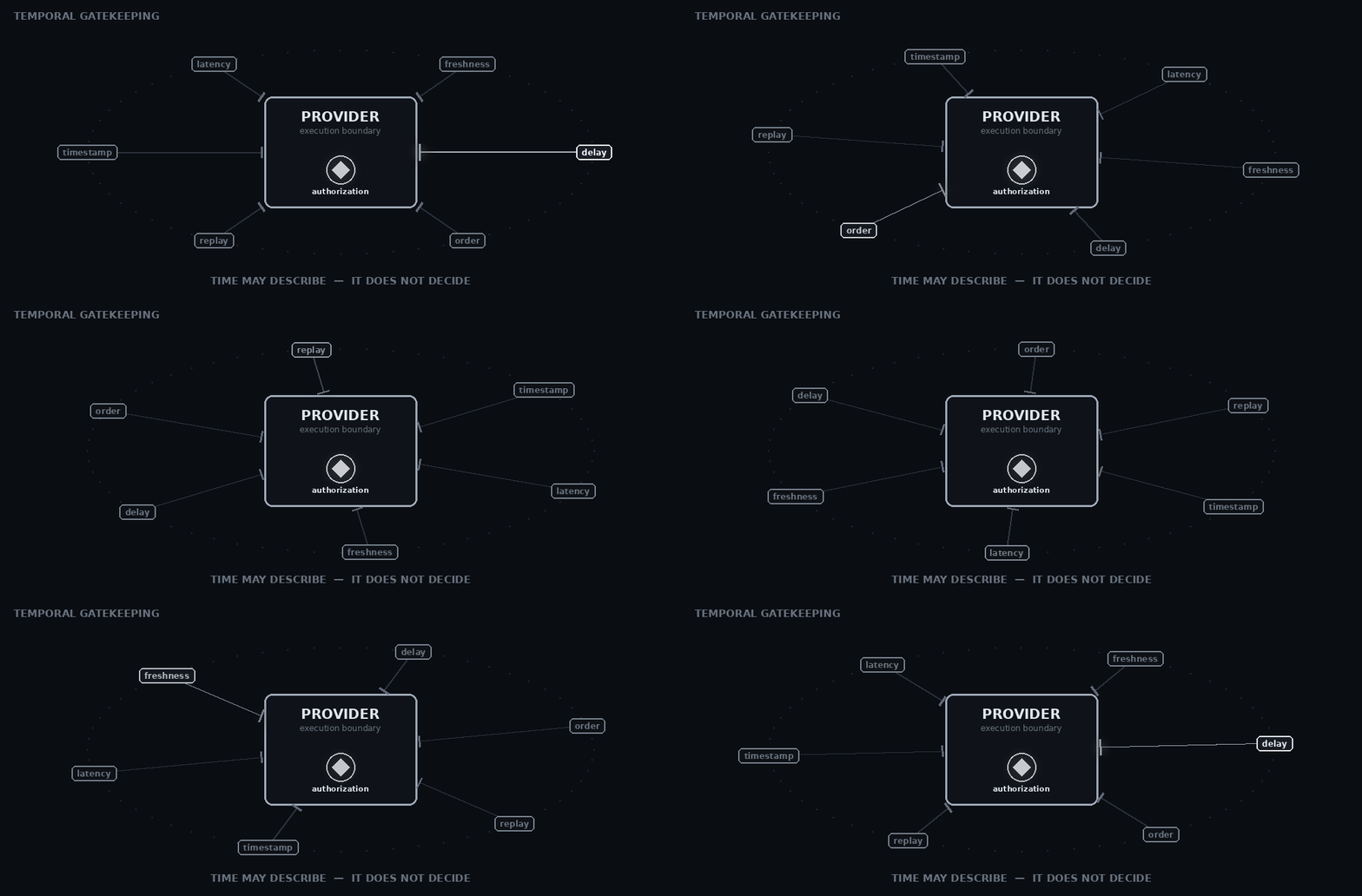
TGATE keeps time-related properties from becoming authority.
Time may describe.
It does not decide.
Scenario
A provider-controlled system executes an operation and generates a verification assertion. That assertion may include temporal context, or it may be observed, conveyed, delayed, repeated, reordered, or recorded by systems outside the provider boundary.
In conventional systems, timing often becomes more than context. Arrival order may be treated as causality. Delay may be treated as staleness. Repetition may be treated as replay. A timestamp may be treated as continuing validity, revocation status, or future authorization.
That is the boundary failure.
Each is a reading.
None is the provider's decision.
TGATE constrains timing, ordering, delay, repetition, and observation so those properties cannot determine authorization, execution meaning, or verification semantics outside the provider-controlled environment.
What It Is
TGATE is a constraint framework for provider-controlled verification where time-related properties are treated as non-authoritative unless the provider gives them meaning inside its own boundary.
A verification assertion may be bound to a provider-defined execution event. It may reference time, sequence, observation, delay, or conveyance context. Those references are treated as provider-asserted descriptors, not external sources of authority.
The point is not to eliminate time from the system.
The point is to stop time from becoming a decision-maker.
TGATE preserves the provider's control over authorization and execution semantics even when assertions are delayed, repeated, reordered, or observed asynchronously.
How It Differs
Replay detection asks whether a message has appeared before.
Freshness validation asks whether something is still timely.
Timestamp enforcement asks whether a time value falls inside an acceptable window.
Sequencing systems ask whether events arrived or occurred in an expected order.
Event reconciliation tries to normalize records after gaps, delays, or reordering.
TGATE is narrower. It asks whether temporal properties are being allowed to interpret execution.
OFAG covers one case of this — execution that happens offline or air-gapped, where the delay comes from lost connectivity. TGATE is the general rule behind it: timing, order, and repetition never become authority, connected or not. OFAG is one place TAGATE applies.
TGATE does not introduce clocks, synchronization protocols, temporal authorities, replay services, or coordination mechanisms. It constrains the authority that timing information is allowed to acquire.
A clock may be present.
The clock does not become the provider.
Under Compromise
A compromised intermediary may delay, duplicate, replay, reorder, or selectively forward verification assertions. An observer may see assertions late, out of order, or without full context.
Those conditions can create operational ambiguity. They should not create authorization authority.
Ambiguity is a transport artifact.
It is not a grant of authority.
TGATE keeps that uncertainty from becoming a path for semantic drift, rollback claims, false sequencing, or freshness-based authority outside the provider-controlled boundary.
How It Works
A provider-controlled environment executes an operation under provider-defined authorization logic. The provider may generate one or more verification assertions bound to execution-scoped events.
Those assertions are not representations of ongoing state, continuous validity, revocation status, or future authorization unless the provider expressly defines them that way.
If temporal references are present, they function as provider-asserted execution context descriptors. They do not establish absolute time, causality, cross-system ordering, or synchronization guarantees by themselves.
Intermediaries may convey the assertions. Observers may record them. Receiving systems may later inspect them.
Those systems do not use timing, arrival order, delay, repetition, or observation latency as inputs to authorization evaluation, execution determination, or semantic interpretation.
The provider defines the execution event.
Temporal properties do not redefine it.
What to Measure
In a temporal gatekeeping architecture, the useful measurement is not whether timestamps, order, delay, or replay signals exist.
The useful measurement is whether those properties changed the authority model.
The relevant boundary questions are:
- Did the provider define the execution event and verification meaning?
- Did any external system infer causality from sequence or arrival order?
- Did delay, repetition, or reordering alter provider-defined execution semantics?
- Did a timestamp become evidence of ongoing validity, revocation, or future authorization?
- Did any intermediary, observer, or added clock/replay service gain authority to judge temporal correctness?
TGATE reframes timing around non-authority.
The question is not whether time is recorded.
The question is whether time was allowed to decide.
What It Doesn’t Do
TGATE does not prohibit timestamps, clocks, sequencing data, or replay controls.
It does not prevent providers from using temporal logic inside the provider-controlled boundary.
It does not replace replay protection, logging, monitoring, synchronization, or audit systems.
It does not make delayed or repeated assertions automatically valid.
It constrains temporal properties from becoming external authority.
Nothing more.
Where It Fits
TGATE is one of eleven modules in the Xer0trust boundary architecture.
Time may describe.
It does not decide.