Module / LSREV
Ledger State Reliance in Execution Verification
LSREV constrains ledger, blockchain, smart-contract, and supply-chain records so ledger state, consensus, finality, settlement, or derived state cannot substitute for provider-controlled execution verification, authorization, or execution authority.
The ledger may remember.
It does not rule.
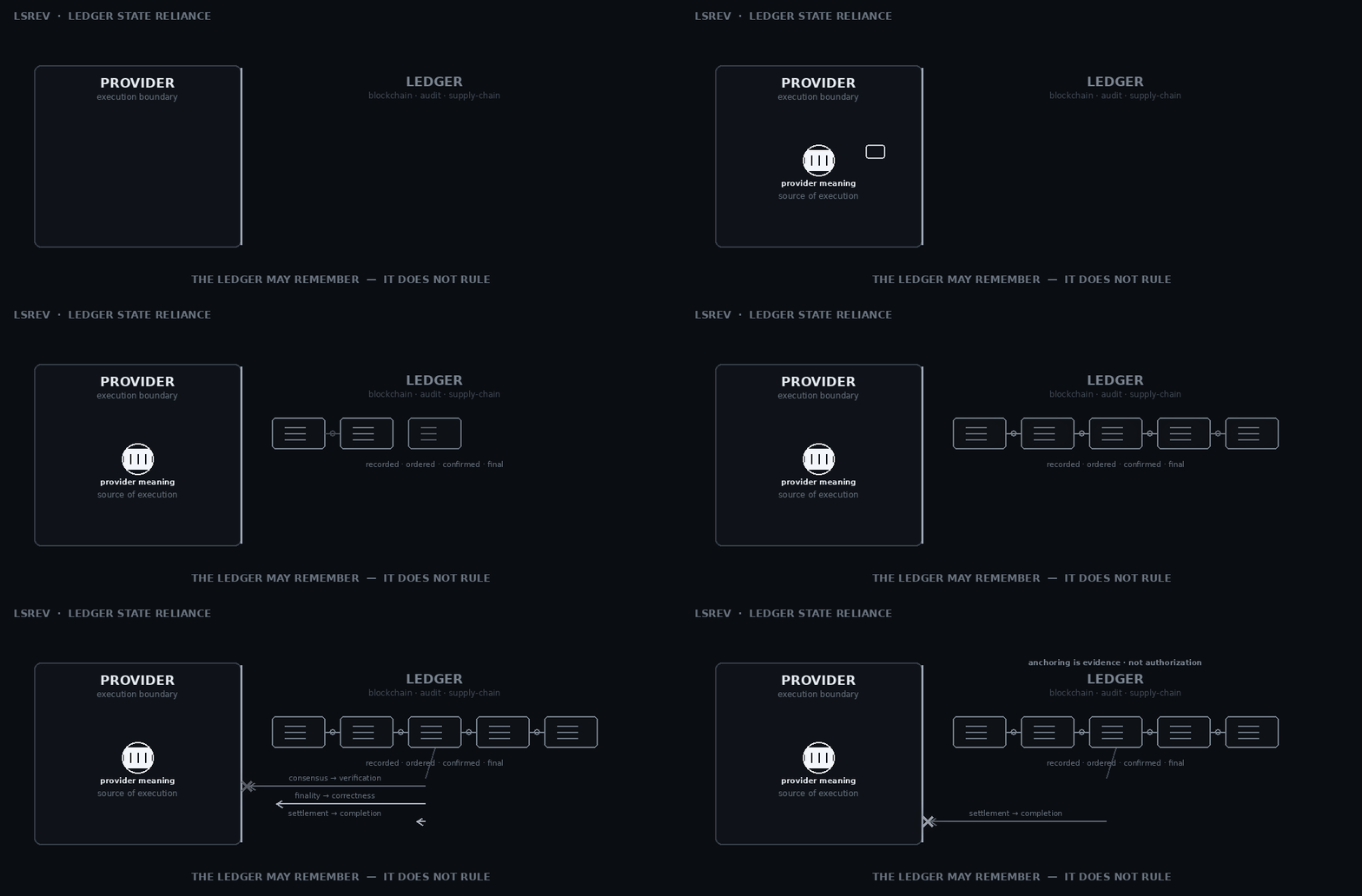
Scenario
A provider-controlled system executes an operation and generates an execution-related assertion. That assertion may later be recorded, referenced, mirrored, or propagated through a blockchain, distributed ledger, smart-contract workflow, audit system, compliance system, or supply-chain tracking platform.
That can be useful. A ledger may provide persistence, visibility, ordering, timestamping, auditability, or shared reference.
The failure begins when those properties are treated as authority.
A ledger record may be treated as proof that execution was correct. Consensus may be treated as verification. Confirmation may be treated as authorization. Settlement may be treated as completion. A smart contract may be treated as if it can resolve provider execution meaning.
That is the boundary failure. A ledger can preserve a record, but it cannot become the provider.
LSREV constrains ledger participation so external records remain passive representations of provider-asserted execution boundaries.
What It Is
LSREV is a constraint framework for ledger-connected execution verification architectures.
It allows provider-generated execution assertions to be recorded, referenced, mirrored, or propagated through distributed ledgers, blockchains, smart-contract systems, or supply-chain tracking environments.
Those records are treated as external representations of provider assertions. They may support audit, reporting, monitoring, tracking, or later reference.
They do not become provider authorization, execution correctness, or policy satisfaction.
The provider remains the source of execution meaning. Ledger participation does not expand the authority model merely because the record is persistent, ordered, confirmed, or widely visible.
How It Differs
Blockchain verification often focuses on integrity, consensus, immutability, and shared state.
Smart-contract systems may enforce on-chain rules or update on-chain state.
Supply-chain provenance systems track custody, movement, status, or reported events.
Audit systems may preserve records for later review.
LSREV is narrower. It asks whether ledger state is being allowed to stand in for provider-controlled execution meaning.
AEBS covers how verification artifacts move across boundaries without moving authority with them. LSREV covers what ledger state is allowed to prove after a provider assertion has been recorded.
Temporal gatekeeping constrains timing and ordering from becoming authority. LSREV applies that same boundary discipline to ledger ordering, confirmation, finality, settlement, and derived state.
LSREV does not treat consensus as provider verification. It does not treat finality as execution completion. It does not treat smart-contract evaluation as provider authorization.
The ledger may confirm its own state, but it does not confirm the provider’s execution authority.
Under Compromise
A compromised ledger-connected component may publish incomplete, delayed, duplicated, misleading, or selectively presented records. A smart-contract workflow may emit a result that appears final inside the ledger environment. An audit or supply-chain system may overread ledger presence as proof of execution truth.
Those failures can affect reporting, visibility, compliance posture, and downstream interpretation. They should not move execution authority into the ledger layer.
Finality is not correctness.
Settlement is not execution.
LSREV prevents ledger state, consensus outcomes, smart-contract results, and audit consumption from becoming de facto authority over provider-controlled execution.
How It Works
A provider-controlled environment executes an operation under provider-defined authorization logic. The provider generates an execution-related assertion corresponding to an execution boundary or provider-defined outcome.
That assertion may be externalized as a representation and recorded or referenced by a ledger-connected system.
The ledger stores or propagates the representation. It may order the representation relative to other records. It may confirm inclusion, settlement, or finality within its own system.
Those ledger properties remain ledger properties. They do not alter provider-defined execution semantics, validate execution correctness, create authorization, or complete an operation that the provider did not complete.
Smart contracts, audit systems, compliance systems, and supply-chain platforms may consume ledger-anchored representations for reference. They do not become verifiers, adjudicators, policy engines, or execution coordinators unless the provider-controlled architecture explicitly gives them such a role.
The provider defines the execution boundary. The ledger records a representation of it.
What to Measure
In a ledger-connected verification architecture, the useful measurement is not simply whether a record is immutable, confirmed, or available.
The useful measurement is whether ledger participation changed the authority model.
The relevant boundary questions are:
- Did the provider generate the execution assertion under provider control?
- Did ledger state become evidence of execution correctness, policy satisfaction, or authorization outcome?
- Did consensus, ordering, confirmation, finality, or settlement change provider-defined execution meaning?
- Did a smart contract, audit layer, compliance system, or supply-chain platform become a verifier or adjudicator?
- Could removing the ledger record change visibility without changing provider-controlled execution authority?
LSREV reframes ledger use around authority containment. The question is not whether the ledger can preserve the record, but whether the record was allowed to rule.
What It Doesn’t Do
LSREV does not prohibit blockchain, ledger, smart-contract, audit, or supply-chain systems.
It does not prevent provider assertions from being recorded, mirrored, referenced, or reported.
It does not deny that ledger systems can provide integrity, ordering, persistence, or shared visibility.
It does not make ledger finality equivalent to provider execution or replace provider-side verification, authorization, execution controls, logging, or audit review.
It constrains what ledger state is allowed to prove.
Nothing more.
Where It Fits
LSREV is one of eleven modules in the Xer0trust boundary architecture.
The ledger may remember.
It does not rule.