Module / QIMSEE
Quantum Influenced Measurement-Sensitive Execution Environments
QIMSEE preserves provider-controlled meaning when observation cannot be assumed passive.
Observation may affect state.
It does not define meaning.
Scenario
A provider-controlled system executes an operation in an environment where observation, measurement, or evaluation may affect system state. The environment may be quantum-influenced, physically measurement-sensitive, non-deterministic, or otherwise incompatible with ordinary assumptions about passive inspection and repeatability.
The provider generates a verification assertion associated with an execution boundary. That assertion may later be conveyed to an intermediary, receiving system, observer, log, or coordination layer.
In conventional verification systems, outside components may try to inspect, replay, compare, normalize, or statistically reconcile an assertion. They may treat variation as evidence of inconsistency, treat repetition as reproducibility, or infer internal state from observed behavior.
That is the boundary failure.
A second look may not be neutral.
It is not a second authority.
QIMSEE prevents external observation from becoming a substitute for provider-controlled execution meaning.
What It Is
QIMSEE is a constraint framework for verification in quantum-influenced or physically measurement-sensitive execution environments.
It treats verification assertions from those environments as provider-asserted boundary representations. The assertion may show that the provider generated a boundary representation, but it does not expose reproducible internal state, causal explanation, or inspectable execution behavior.
The module does not introduce a quantum mechanism, validator, evaluator, or new verification protocol. It constrains what outside systems are allowed to do with assertions after they leave the provider boundary.
The assertion may be observable.
Its meaning remains provider-bound.
How It Differs
Quantum cryptography protects communication or key exchange.
Quantum computing security addresses systems that operate with quantum hardware, algorithms, or quantum-influenced behavior.
Probabilistic validation asks whether variation can be explained statistically.
Replay analysis asks whether a prior signal can be reused or compared.
Measurement attestation may support claims about an environment or device state.
QIMSEE is narrower. It asks whether outside systems are imposing classical verification assumptions on an assertion from a measurement-sensitive environment.
DCV constrains what observation can read from an assertion. QIMSEE constrains a harder case: environments where observation itself is not passive or repeatable, so re-measurement, replay, and statistics cannot stand in for provider meaning.
QIMSEE does not assume that re-measurement is neutral. It does not assume that replay produces equivalent meaning. It does not let statistical confidence become provider authorization.
Measurement sensitivity is treated as a constraint.
Not as a license to infer.
Under Compromise
A compromised intermediary or receiving system may replay, sample, compare, correlate, delay, or selectively present verification assertions. It may attempt to infer internal execution state, causal behavior, reproducibility, or probabilistic meaning from what it observes.
Those actions may create misleading confidence. They should not create verification authority.
Confidence is not correctness.
A record is not a ruling.
QIMSEE keeps false determinism, semantic leakage, replay misuse, and post hoc inference from becoming paths to authority outside the provider-controlled boundary.
How It Works
A provider-controlled environment executes an operation under provider-defined authorization and control logic. In a measurement-sensitive setting, observation or evaluation may alter state, introduce non-determinism, or invalidate ordinary assumptions about repeatable inspection.
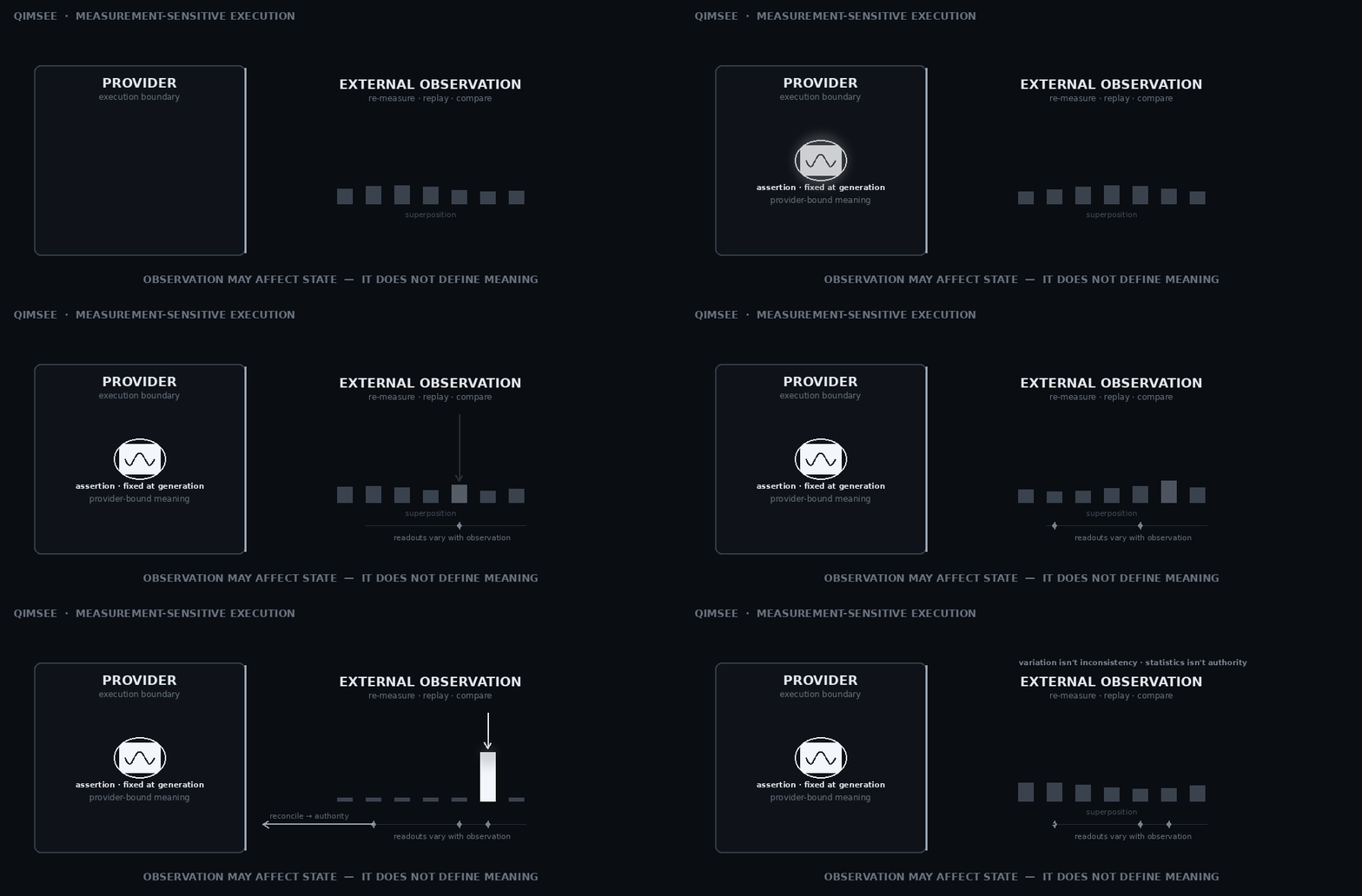
The provider generates a verification assertion corresponding to an execution boundary. That assertion is treated as fixed at generation time under provider control.
Outside the provider boundary, the assertion may be conveyed, observed, stored, or relied upon only as a provider-asserted boundary representation. Intermediaries and receiving systems do not re-measure it, replay it as a test, normalize it into a different meaning, or use probabilistic reconciliation to infer what occurred inside.
The provider controls the execution boundary.
External observation does not reconstruct it.
What to Measure
In a quantum-influenced or measurement-sensitive verification architecture, the useful measurement is not whether an assertion can be reproduced or statistically reconciled.
The useful measurement is whether external reliance stayed inside the intended boundary.
The relevant boundary questions are:
- Was the assertion generated under provider control as an execution boundary representation?
- Did any external system attempt re-measurement, replay-based evaluation, comparison, or normalization?
- Did any intermediary or receiver infer internal state, reproducibility, continuity, or causal explanation?
- Did statistical or probabilistic interpretation become verification authority?
- Did observation, arrival order, repetition, or sampling alter the assertion’s provider-defined meaning?
QIMSEE reframes measurement-sensitive verification around non-inference.
The question is not whether observation occurred.
The question is whether observation was allowed to decide.
What It Doesn’t Do
QIMSEE does not provide quantum cryptography.
It does not prohibit providers from operating quantum-influenced or physically measurement-sensitive systems.
It does not make intermediaries or receivers evaluators of provider-internal behavior.
It does not replace provider-side security, transport security, logging, or audit controls.
It constrains external reliance on assertions whose underlying execution cannot be safely treated as passively observable, repeatable, or reproducible.
Nothing more.
Where It Fits
QIMSEE is one of eleven modules in the Xer0trust boundary architecture.
Observation may affect state.
It does not define meaning.