Module / DCV
Disclosure-Constrained Verification Artifacts
DCV constrains verification artifacts so they can preserve integrity, authenticity, and auditability while limiting inferable provider-internal evaluation details and without relocating authorization authority or interpretive responsibility.
The boundary can be verified.
Provider reasoning stays inside.
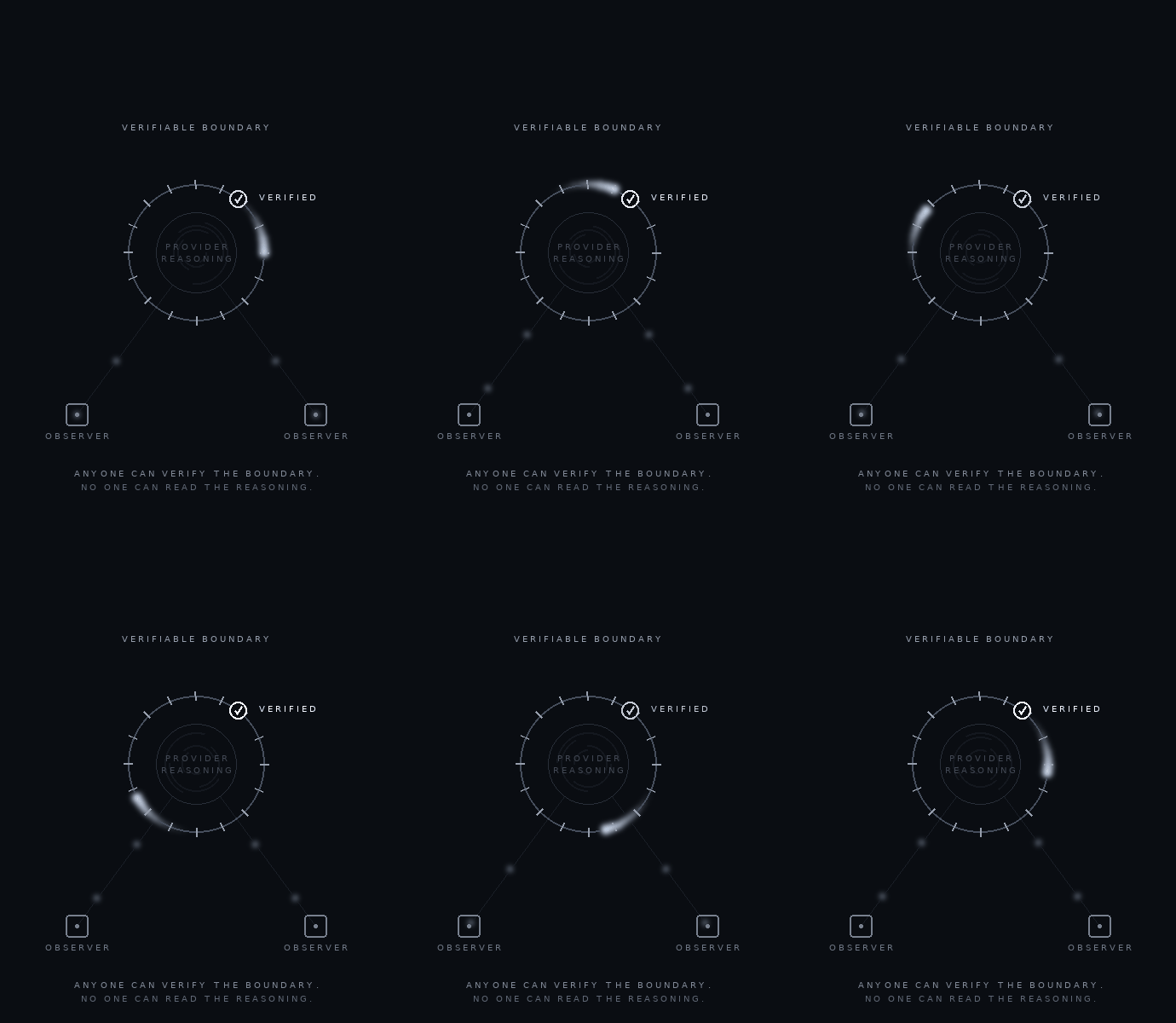
Scenario
A provider evaluates an operation request.
The provider may authorize execution, deny execution, defer execution, or generate an execution boundary artifact.
That artifact may need to move outside the provider-controlled environment.
It may be conveyed through an intermediary, logged, observed, audited, or associated with other boundary evidence.
In a conventional design, the artifact may carry more than the outside system needs.
It may expose policy structure, decision criteria, contextual inputs, or adaptive evaluation behavior.
Signing the artifact may prove that it was not modified.
It does not necessarily limit what the artifact reveals.
DCV treats that as the boundary problem.
The artifact may support verification.
It should not expose provider-internal reasoning merely because it is observable.
What It Is
DCV is an architecture for generating and using disclosure-constrained verification artifacts in provider-controlled execution systems.
A provider-controlled environment receives and evaluates an operation request.
Execution occurs only under provider control.
The provider may generate a verification artifact associated with execution, ordering, sufficiency of evaluation, or an execution boundary.
The artifact may be cryptographically protected.
It may preserve integrity, authenticity, and auditability.
It may also be constructed to limit what non-provider systems can infer from it.
The goal is not only to prevent alteration.
The goal is to prevent unnecessary disclosure of provider-internal evaluation details.
The artifact can indicate that a provider-controlled boundary condition was satisfied without exposing provider policy logic, adaptive model behavior, or evaluation rationale.
DCV separates verification usefulness from internal disclosure.
How It Differs
Encryption protects artifact content from unauthorized readers.
Redaction removes visible fields.
Zero-knowledge techniques may prove a statement without revealing selected inputs.
Audit logs preserve evidence after an event.
Confidential computing attestation may support claims about an execution environment.
DCV is narrower.
It is not a single cryptographic method.
It is a constraint on what verification artifacts allow outsiders to infer.
DCV does not move authorization into the artifact.
It does not make the intermediary a verifier of provider policy.
It does not require shared interpretation logic outside the provider.
The artifact may be observable.
Provider reasoning remains provider-side.
Under Compromise
A compromised intermediary may copy, delay, replay, correlate, withhold, or misroute verification artifacts.
It may attempt to infer provider behavior from artifact structure, timing, frequency, or exposed fields.
It may attempt to treat the artifact as authorization.
Those risks affect disclosure and misuse.
They should not move execution authority into the intermediary.
They should not make the intermediary responsible for provider-internal meaning.
They should not convert artifact possession into authorization.
A disclosure-constrained artifact can reduce what an observer can infer.
It does not make an untrusted observer trustworthy.
It keeps the artifact from revealing more than the architecture intends to reveal.
How It Works
A provider-controlled environment receives an operation request.
The provider evaluates the request using provider-controlled logic.
That logic may include rules, contextual conditions, adaptive mechanisms, or other provider-selected methods.
If provider-defined evaluation is satisfied, execution occurs inside the provider-controlled environment.
The provider generates a verification artifact associated with the operation or execution boundary.
The artifact may include signatures, commitments, or other provider-selected cryptographic constructions.
Those constructions constrain what can be inferred from the artifact.
They do not change who authorizes execution.
They do not change execution semantics.
They do not transfer interpretive responsibility outside the provider-controlled environment.
The artifact may be conveyed through existing routing, transport, logging, monitoring, reconciliation, or coordination mechanisms.
Intermediaries and endpoints may observe or store the artifact.
They are not relied upon to evaluate provider-side sufficiency, interpret provider policy, or determine execution outcomes.
The provider controls the meaning.
The artifact limits what others can infer.
What to Measure
In a disclosure-constrained verification architecture, the useful measurement is not simply whether the artifact exists.
The useful measurement is what the artifact reveals.
The relevant boundary questions are:
- What provider-internal details can a non-provider observer infer from the artifact?
- Does the artifact expose policy logic, decision criteria, contextual inputs, or adaptive evaluation behavior?
- Does the artifact preserve integrity, authenticity, and auditability while limiting disclosure?
- Does the disclosure-limiting construction change authorization authority or execution semantics?
- Are intermediaries or endpoints required to interpret artifact content?
- Can possession or observation of the artifact be mistaken for execution authority?
- Would removing the disclosure-limiting construction change authority placement, or only disclosure exposure?
DCV reframes verification artifacts around inferable information.
The question is not only whether the artifact can be trusted.
The question is what the artifact teaches an observer.
What It Doesn’t Do
DCV does not authorize execution.
It does not replace provider-side evaluation.
It does not make the artifact an execution authority.
It does not make intermediaries responsible for interpreting provider policy.
It does not require a specific cryptographic technique.
It does not require zero-knowledge proofs in every implementation.
It does not require interactive challenge-response with intermediaries.
It does not guarantee that all metadata is hidden.
It does not prevent a provider from intentionally disclosing selected information.
It does not replace transport security, logging, monitoring, or audit controls.
It constrains what verification artifacts reveal while preserving provider-controlled authority.
Where It Fits
DCV is one of eleven modules in the Xer0trust boundary architecture.
The boundary can be verified.
Provider reasoning stays inside.