Module / MH
Multi-Hub Stateless Intermediation
MH allows multiple coordination hubs to route, dispatch, and relay operation requests or outcome signals without causing any hub to acquire execution authority, provider logic, provider-specific semantics, or provider execution state.
Every hub may route.
No hub may execute.
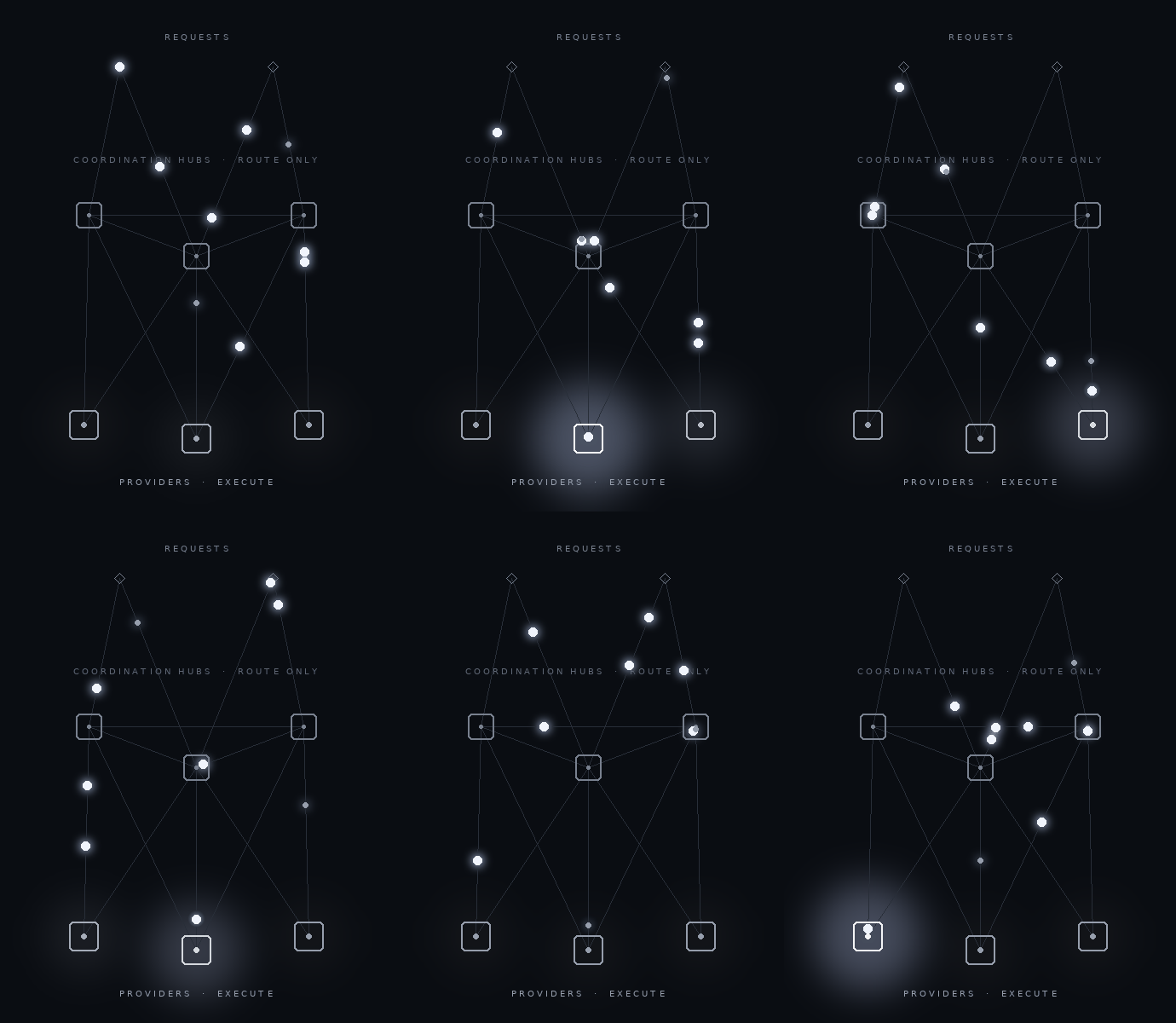
Scenario
A request needs to reach one or more provider systems.
It may pass through a single coordination hub.
It may pass through several hubs.
It may be routed to multiple providers, relayed across domains, or returned with provider outcome signals.
The problem is not that hubs exist.
The problem is what hubs are allowed to become.
In conventional coordination systems, a hub can become a workflow owner, policy checkpoint, semantic interpreter, retry authority, state holder, or outcome resolver.
That collapses routing into execution control.
MH separates the two.
Hubs may coordinate the path.
Providers determine execution.
No hub becomes the shared authority merely because the request passed through it.
What It Is
MH is a stateless intermediation architecture for multi-hub systems.
It defines coordination hubs that receive operation requests, apply routing configuration, and forward requests or request representations toward provider systems.
A hub may route, dispatch, relay, fan out, or report.
A provider evaluates the received request using its own execution logic, policy framework, control mechanisms, and internal state.
The provider may execute, reject, defer, or return another provider-defined outcome.
The hub may receive an outcome signal.
It may relay that signal.
It may record that signal for coordination or reporting.
It does not determine what the signal means inside the provider.
It does not decide whether the provider succeeded.
It does not resolve provider conflicts as an execution authority.
The hub coordinates movement.
The provider owns execution.
How It Differs
Workflow orchestration systems commonly control task order, dependency handling, retries, and execution flow.
Enterprise service buses and message brokers may normalize, transform, enrich, or route messages according to shared integration logic.
API gateways and service meshes may enforce identity, policy, access rules, telemetry, or service-to-service control.
MH is narrower.
MH does not make the hub a workflow owner.
It does not make routing configuration a substitute for provider authorization.
It does not require the hub to understand provider-specific execution semantics.
It does not require the hub to retain provider execution state.
It does not make any hub responsible for provider behavior.
The defining question is not whether the hub can move the request.
The defining question is whether the hub owns what happens after the provider receives it.
Under Compromise
A compromised hub may disrupt routing.
It may drop, delay, duplicate, misroute, replay, reorder, or withhold requests or outcome signals.
It may apply routing configuration incorrectly.
It may interfere with availability.
It may disrupt coordination across the hub layer.
It cannot execute provider logic merely by sitting in the path.
It cannot determine provider authorization.
It cannot convert routing position into execution authority.
It cannot become the authoritative interpreter of provider outcomes.
It cannot acquire shared execution state across providers unless the architecture gives it that state.
A compromised hub can break movement.
It should not be able to become the executor.
How It Works
MH uses one or more coordination hubs.
A hub receives an operation request from a requesting entity.
The request contains enough information for routing, not enough authority for provider execution.
The hub applies routing configuration.
That configuration may identify destination providers, eligibility rules, ordering, or routing preferences.
The hub applies the configuration as coordination logic.
It does not evaluate provider execution logic.
It does not decide whether a provider should execute.
It forwards the request, or a representation of the request, to one or more providers.
Each provider processes the request independently.
The provider controls its own authorization, execution, deferral, and outcome generation.
The hub may receive outcome signals from providers.
It may relay those signals to another hub, requesting entity, reporting layer, or downstream component.
In a multi-hub deployment, hubs may relay requests or outcome signals among one another.
Each hub remains a coordination component.
No hub becomes a centralized execution authority.
What to Measure
In a multi-hub architecture, the useful measurement is not simply whether a request moved through the hub layer.
The useful measurement is whether the hub layer stayed out of execution control.
The relevant boundary questions are:
- Did any hub retain provider execution state?
- Did any hub interpret provider-specific execution semantics?
- Did any hub authorize or deny execution on behalf of a provider?
- Did any hub resolve provider outcome conflicts as an execution authority?
- Did multiple hubs create a shared control plane for provider execution?
- Could each provider evaluate and respond without surrendering internal logic to the hub layer?
MH reframes routing around authority containment.
The question is not whether every hub can coordinate.
The question is whether any hub became the owner.
What It Doesn't Do
MH does not execute provider logic.
It does not authorize operation requests on behalf of providers.
It does not determine provider execution outcomes.
It does not retain provider execution state.
It does not require providers to expose internal policy logic, execution semantics, or state transitions.
It does not require all hubs to share centralized control authority.
It does not require a hub to resolve conflicts between provider outcomes.
It does not replace provider-side security.
It does not turn routing configuration into provider execution authority.
It keeps coordination separate from execution.
Where It Fits
MH is one of eleven modules in the Xer0trust boundary architecture.
Every hub may route.
No hub may execute.