Module / AEBS
Artifact Exchange and Boundary Signaling
Verification artifacts can move across systems without moving authorization authority with them.
Artifacts travel.
Authority does not.
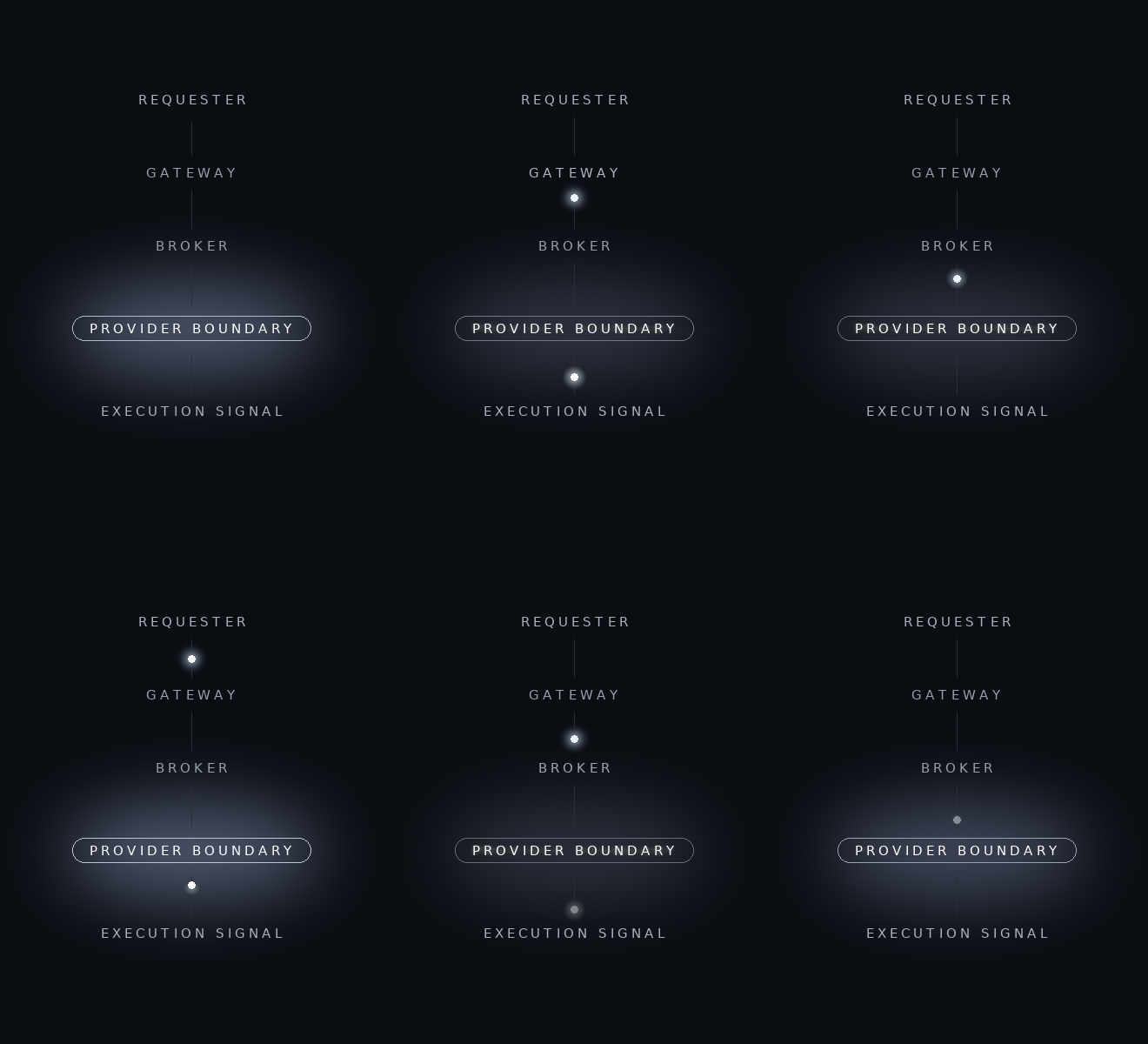
Scenario
An AI agent invokes a tool through an orchestration layer.
The request may pass through a gateway, broker, queue, relay, service mesh, or integration platform before it reaches the system that can actually perform the operation.
In a conventional design, those intermediate systems may be asked to interpret tokens, apply policy assumptions, inspect metadata, or decide whether the request should proceed.
AEBS treats that as the boundary failure.
The intermediary may carry the verification artifact.
The provider determines whether the artifact authorizes execution.
Execution begins only after provider-side evaluation.
What It Is
AEBS is a provider-controlled framework for exchanging verification artifacts associated with operation requests while preserving provider control over authorization, execution, and lifecycle boundary signaling.
It separates conveyance from authority.
An intermediary may receive, forward, route, queue, broker, or relay a verification artifact.
The provider evaluates the artifact using provider-selected logic.
If the provider authorizes the operation, execution is initiated inside the provider boundary.
Artifact exchange and boundary signaling belong in the same module because both depend on provider-originated meaning: the path may carry the artifact or observe a signal, but the provider determines authorization and execution lifecycle state.
How It Differs
API gateways and service meshes commonly centralize policy enforcement, identity handling, routing rules, authorization checks, telemetry, and service-to-service control behavior.
AEBS is different.
AEBS does not make the intermediary an authorization authority. It does not require the gateway, broker, relay, or mesh layer to understand the artifact’s meaning. It does not move provider policy into shared infrastructure.
The intermediary transports.
The provider decides.
Under Compromise
A compromised intermediary may interfere with availability.
It may drop, delay, duplicate, reorder, or attempt to replay artifacts depending on the surrounding implementation.
It cannot manufacture provider authorization merely by being in the path.
It cannot convert transport possession into execution authority.
It cannot decide that a request is valid unless the provider evaluates the artifact and initiates execution.
How It Works
AEBS supports provider-generated execution boundary signals.
These signals may represent lifecycle stages such as:
- Initiation
- Intermediate progression
- Completion
- Other provider-defined execution boundaries
Boundary signals are generated by the provider. They are not inferred by the intermediary, created by the routing layer, or delegated to shared policy infrastructure.
What to Measure
In a provider-first implementation, the useful measurement is not whether traffic reached an intermediary.
It is whether a request that the provider later rejects caused downstream execution, data access, or provider-side effects before authorization.
AEBS is designed for paths where proof of conveyance is not enough.
The relevant boundary question is whether authority moved with the artifact.
What It Doesn't Do
AEBS does not turn the intermediary into an authorization service.
It does not require the intermediary to understand verification semantics.
It does not expose provider-internal policy logic.
It does not require shared enforcement.
It does not require identity propagation across the full request path.
It does not replace provider-side security.
Where It Fits
AEBS is one of eleven modules in the Xer0trust boundary architecture.
These modules are designed prevent routing infrastructure, brokers, intermediaries, hubs, adaptive systems, or shared control planes from acquiring execution authority merely because they participate in the request path.
Artifacts travel.
Authority does not.