Module / MPBS
Multi-Provider Boundary Signaling
MPBS confirms execution progress across independent providers without centralizing control over the workflow.
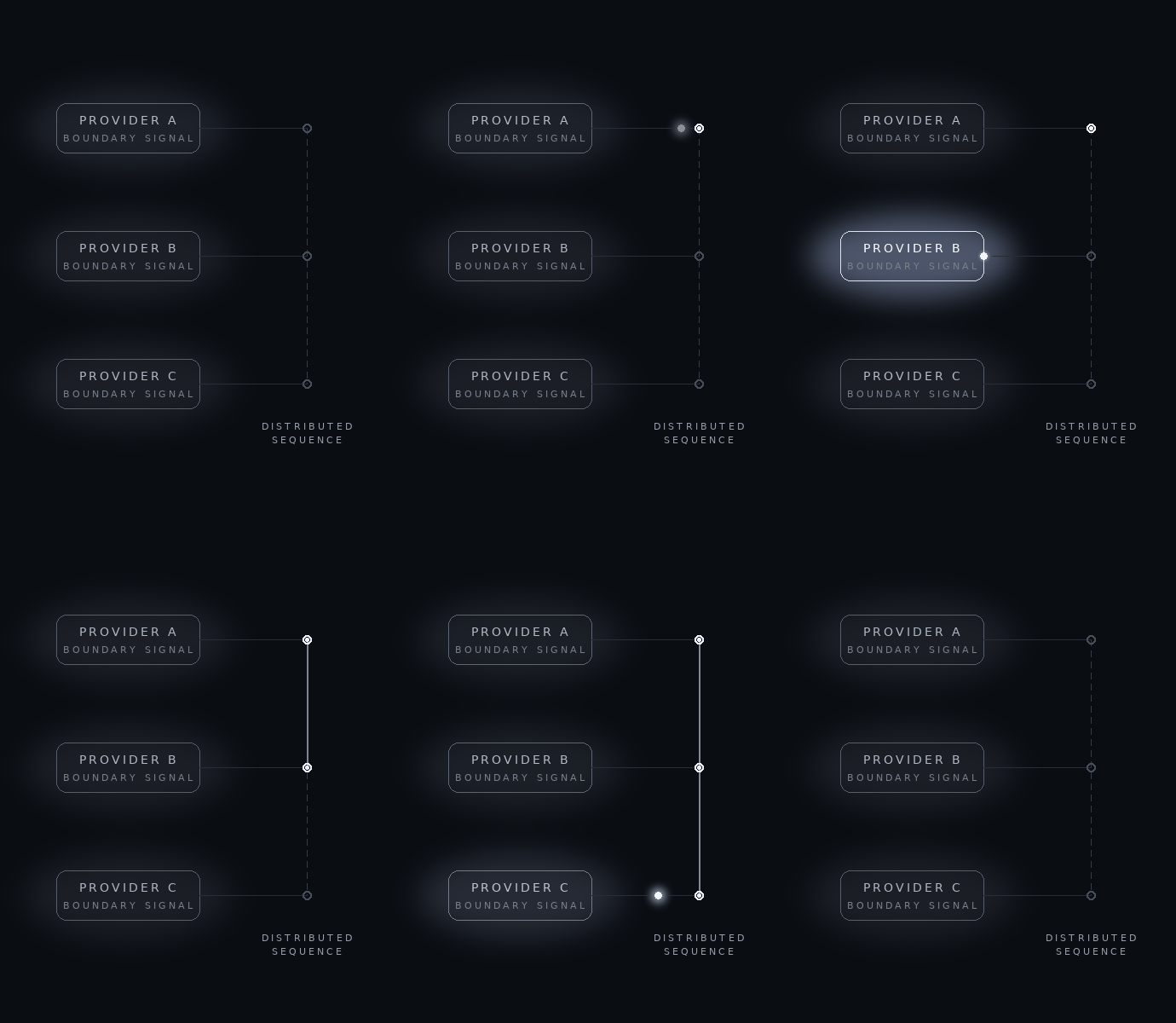
Each provider marks its boundary.
The path is assembled, not owned.
Scenario
A workflow spans several independent systems.
An AI agent may invoke a model provider, retrieve data from a separate service, call a tool through an integration layer, and trigger a downstream action in another provider environment.
Each provider can observe its own execution boundary.
No provider can safely observe the whole workflow.
No shared intermediary should be required to understand provider-internal execution logic, enforce another provider’s policy, or decide whether the distributed operation completed correctly.
MPBS addresses that gap.
Each provider contributes boundary values for the execution events it controls.
Those values can be associated into a distributed boundary sequence.
The sequence can confirm that a multi-provider operation began, progressed, and completed without making any single participant the owner of the full execution path.
What It Is
MPBS is a framework for distributed execution boundary verification across multiple independent providers.
Each provider generates boundary values inside its own environment.
Those values correspond to provider-controlled execution events, such as initiation, progression, completion, termination, or another lifecycle boundary defined by that provider.
The boundary values are then associated into a distributed sequence.
That sequence represents the execution path of a logical operation spanning multiple providers.
MPBS does not centralize authorization.
It does not require shared execution state.
It does not require one provider to disclose internal logic to another provider.
It confirms distributed execution through provider-originated boundary signals.
How It Differs
Distributed tracing records observable service activity.
Workflow orchestration coordinates tasks.
Audit logging preserves event records.
MPBS is different.
MPBS does not infer execution boundaries from telemetry.
It does not rely on a central orchestrator to decide whether execution was correct.
It does not reconstruct a provider’s internal state from logs.
The provider generates its own boundary signal.
The association layer links boundary values.
The distributed sequence confirms that provider-controlled boundary events occurred across the workflow.
Under Compromise
A compromised intermediary or association component may interfere with availability or presentation.
It may drop, delay, omit, duplicate, reorder, or attempt to replay boundary values depending on the surrounding implementation.
It cannot manufacture a valid provider-originated boundary value.
It cannot convert correlation into authorization.
It cannot decide that another provider executed correctly.
It cannot acquire authority over a provider’s internal execution environment merely because it participates in the boundary-signaling path.
How It Works
MPBS uses provider-generated execution boundary values.
A provider creates a boundary value when a relevant execution event occurs inside its own environment.
Another provider does the same for its portion of the workflow.
Those values are contributed to a distributed boundary-signaling process.
The values may be ordered, partially ordered, or correlated depending on the workflow.
The resulting boundary sequence provides a way to confirm distributed execution progress without requiring any participant to expose provider-internal execution logic.
Optional anchoring may record boundary values or boundary sequences in an integrity-preserving system.
Anchoring may support auditability or tamper resistance, but it does not change the authority model.
The provider still controls boundary generation.
The association layer only relates what providers contribute.
What to Measure
In a multi-provider workflow, the useful measurement is not whether a central service observed activity across the path.
It is whether each participating provider contributed a valid boundary signal for the portion of execution it controlled.
MPBS reframes verification around boundary coverage, not trace visibility.
The relevant boundary questions are:
- Did each participating provider contribute its own boundary value?
- Were those values associated into the expected distributed sequence?
- Did confirmation require shared execution state?
- Did any intermediary need to interpret provider-internal semantics?
- Did any non-provider acquire authority over the workflow?
MPBS is designed for environments where proof of distributed execution matters, but centralized ownership of the execution path is not acceptable.
What It Doesn't Do
MPBS does not authorize the underlying operation.
It does not execute the workflow.
It does not determine whether a provider’s internal execution was correct.
It does not require providers to disclose internal policy logic, operational metadata, system state, or execution semantics.
It does not require a centralized authority to enforce workflow order.
It does not require synchronous participation by all providers.
It does not replace distributed tracing, logging, audit systems, or provider-side security.
It does not make an intermediary responsible for another provider’s execution boundary.
Where It Fits
MPBS is one of eleven modules in the Xer0trust boundary architecture.
These modules are designed prevent routing infrastructure, brokers, intermediaries, hubs, adaptive systems, or shared control planes from acquiring execution authority merely because they participate in the request path.
Each provider marks its boundary.
The path is assembled, not owned.