Module / MDSV
Multi-Domain Stateless Verification
Verification can cross independent technical domains without requiring shared execution state, centralized control, or disclosure of domain-internal execution logic.
Domains verify.
State does not have to follow.
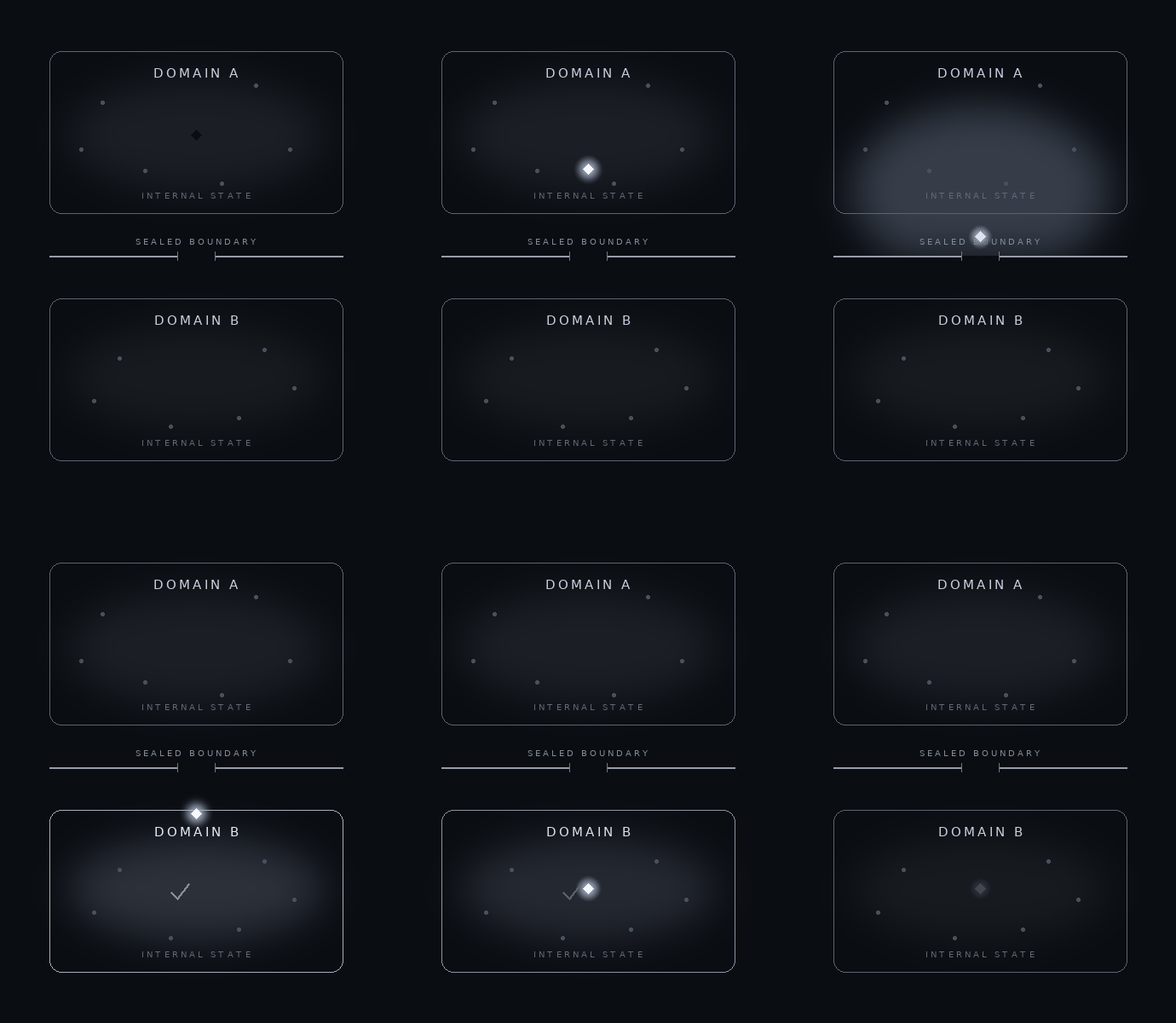
Scenario
A request, event, action, or condition occurs inside one technical domain.
Another domain may need to verify that the event occurred, that an operation completed, that a condition was satisfied, or that an asserted outcome is valid.
The domains may be operated by different organizations, infrastructure providers, administrative authorities, or control environments. They may not share identity systems, policy engines, session context, operational state, or internal execution semantics.
In a conventional design, cross-domain verification often becomes dependent on a shared control plane, persistent session context, centralized authorization logic, or a trusted intermediary that interprets internal state on behalf of multiple systems.
MDSV treats that as the boundary problem.
A domain may generate or accept a verification artifact.
Another domain may evaluate that artifact according to its own criteria.
The domains do not need to expose internal execution logic to make verification possible.
What It Is
MDSV is a stateless verification architecture for environments where verification must occur across multiple independent technical domains.
It supports verification artifacts, signals, or assertions that represent externally verifiable outcomes associated with events, actions, or conditions occurring inside domain-controlled environments.
Each participating domain remains responsible for its own execution logic, internal state, policy criteria, and trust model.
Verification is decoupled from shared execution state.
A domain may generate an artifact from a domain-local event.
Another domain may receive, interpret, or evaluate that artifact without requiring access to the originating domain’s internal control flow, state transitions, optimization logic, or proprietary process logic.
The purpose is not to make every domain share the same trust model.
The purpose is to allow verification across domains without collapsing those domains into one shared authority.
How It Differs
MDSV is easy to confuse with cross-domain identity federation, centralized trust brokerage, or a shared policy control plane.
Those systems commonly depend on common identity infrastructure, persistent session context, synchronized state, shared authorization logic, or an intermediary that enforces policy across multiple environments.
MDSV is different.
It does not require participating domains to share execution state.
It does not require a centralized authorization authority.
It does not require intermediaries to evaluate policy or interpret internal execution semantics.
It does not require every domain to adopt the same trust model.
A domain can verify an artifact according to domain-specific criteria without inheriting the originating domain’s internal state or surrendering its own decision boundary.
The connection is verifiable.
The control plane is not shared.
Under Compromise
A compromised intermediary may interfere with availability.
It may drop, delay, duplicate, reorder, withhold, or attempt to replay verification artifacts depending on the surrounding implementation.
It may disrupt conveyance.
It cannot become a domain’s internal execution authority merely by sitting between domains.
It cannot require participating domains to share execution state.
It cannot convert relay position into access to internal domain logic, state transitions, or proprietary control flow.
It cannot manufacture a domain-originated verification outcome unless the relevant domain’s own verification mechanism accepts it as valid.
A compromised receiving component may mis-handle an artifact inside its own domain, but that does not make it authoritative for the originating domain’s internal execution semantics.
How It Works
MDSV relies on discrete verification artifacts, signals, or assertions.
These artifacts may represent verifiable outcomes associated with events, actions, conditions, or domain-local operation boundaries.
A participating domain may generate an artifact from an internal event without exposing the internal execution process that produced it.
That artifact may then be conveyed to another domain directly or through one or more intermediaries.
The receiving domain evaluates the artifact using its own domain-specific criteria, policy, trust model, or verification process.
Intermediaries may function as conduits, relays, registries, routing systems, or transport components.
They are not required to retain operational state.
They are not required to enforce authorization logic.
They are not required to reconstruct prior interactions or synchronized context across domains.
The verification act is based on the artifact, not on shared session continuity or disclosure of internal state.
What to Measure
In a multi-domain environment, the useful measurement is not whether two domains can exchange data.
It is whether verification across those domains required shared execution state, persistent session context, centralized control logic, or disclosure of internal execution semantics.
The relevant boundary questions are:
- Did verification require access to the originating domain’s internal state?
- Did it require reconstruction of internal execution logic or control flow?
- Did an intermediary have to enforce policy on behalf of the participating domains?
- Did the architecture require a shared identity framework or centralized authority?
- Could the artifact be evaluated independently, without accumulated context or synchronized state across domains?
MDSV reframes interoperability around external verifiability without internal state exposure.
What It Doesn't Do
MDSV does not create a universal trust model.
It does not require domains to share identity infrastructure.
It does not require persistent session context across domains.
It does not centralize authorization logic.
It does not make an intermediary responsible for policy enforcement.
It does not require disclosure of internal execution state, control flow, optimization strategy, or proprietary process logic.
It does not replace domain-local security.
It does not guarantee that every receiving domain will interpret an artifact the same way.
It preserves the ability of each domain to evaluate verification artifacts according to its own criteria.
Where It Fits
MDSV is one of eleven modules in the Xer0trust boundary architecture.
These modules are designed prevent routing infrastructure, brokers, intermediaries, hubs, adaptive systems, or shared control planes from acquiring execution authority merely because they participate in the request path.
Domains verify.
State does not have to follow.