Module / HWIoT
Hardware/IoT Endpoint Constraints
HWIoT constrains hardware-limited, embedded, edge, and IoT endpoints so they may emit provider-defined signals without becoming verification authorities, authorization authorities, semantic interpreters, or policy engines.
Devices may signal.
Providers determine meaning.
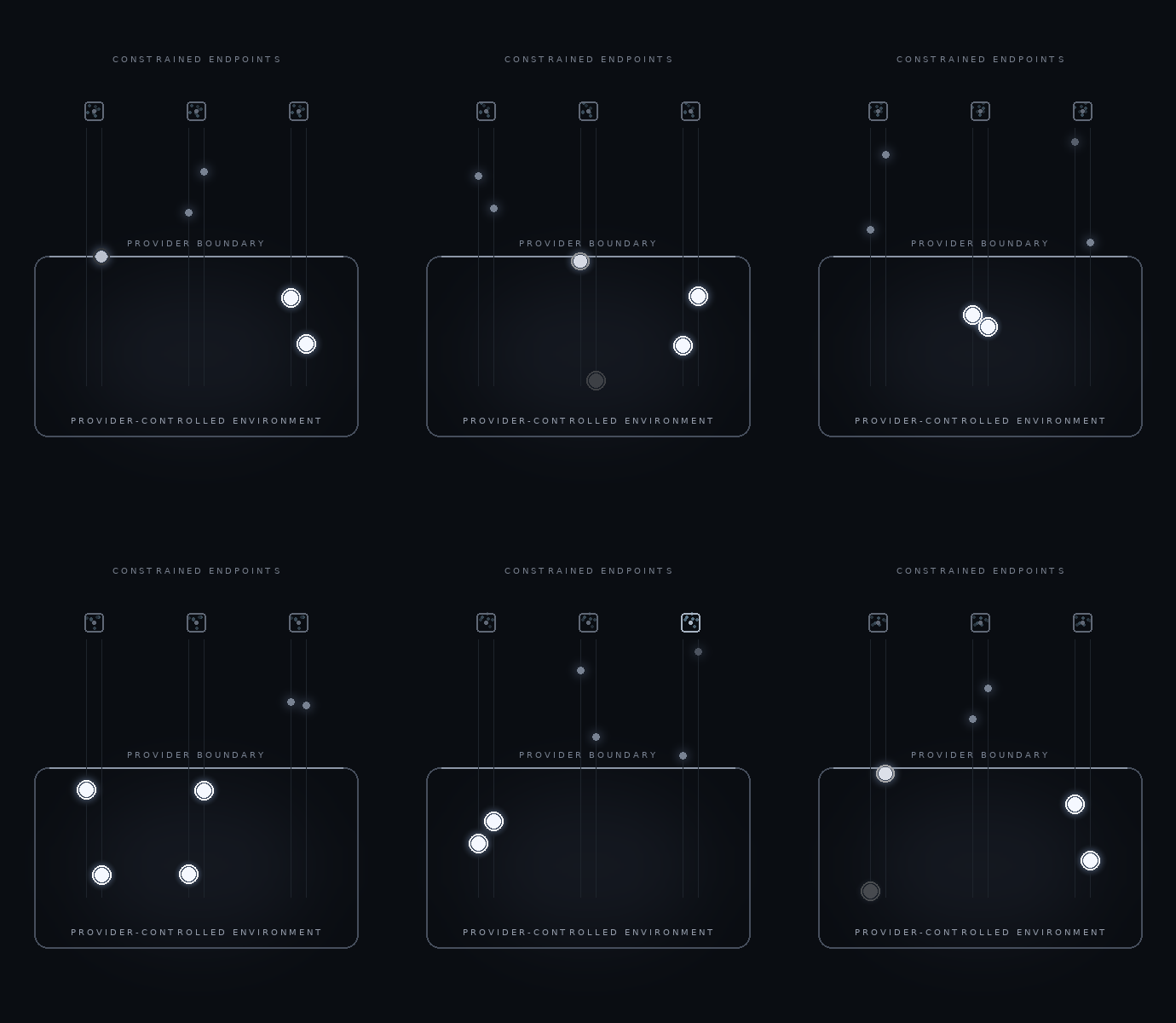
Scenario
A hardware-constrained endpoint observes an event, measures a condition, triggers a request, or emits a signal.
The device may be a sensor, embedded controller, field endpoint, IoT device, gateway-adjacent device, or edge component.
It may operate with limited compute, intermittent power, unreliable connectivity, or partial physical exposure.
A conventional architecture may still treat that endpoint as if it can host reliable identity services, policy logic, cryptographic verification, execution semantics, or adaptive decision-making.
That is the boundary failure.
The device may participate.
It does not become the authority.
A signal may originate at the endpoint.
Meaning, validity, and authorization are determined inside the provider-controlled environment.
What It Is
HWIoT is a constraint framework for hardware-limited, embedded, edge, and IoT endpoints.
It permits constrained endpoints to participate through fixed, provider-defined behaviors.
An endpoint may emit a signal corresponding to an event, measurement, condition, or request.
That signal is treated as a bounded input.
The endpoint is not relied upon to verify the signal.
It is not relied upon to authorize execution.
It is not relied upon to reconcile state.
It is not relied upon to interpret provider semantics.
Any meaning attached to the signal is determined inside the provider-controlled environment.
Intermediaries may carry the signal.
They may forward it toward the provider.
They do not inspect, validate, normalize, or reinterpret it as a source of authority.
HWIoT separates endpoint participation from endpoint authority.
How It Differs
Device authentication asks whether a device can be recognized.
IoT security asks whether the device and its communications can be protected.
Edge computing asks what can be processed near the device.
Embedded attestation asks whether a device can prove something about its software or hardware state.
Gateway normalization asks whether device outputs can be translated into a common format.
HWIoT is narrower.
It asks whether the endpoint is being trusted to do something it should not be required to do.
HWIoT does not assume that a constrained endpoint can reliably host identity services, policy engines, execution stacks, cryptographic verification, or semantic interpretation.
It does not treat local device capability as authorization authority.
It does not let an intermediary become a verifier merely because the signal came from constrained hardware.
The endpoint emits.
The provider determines.
Under Compromise
A compromised endpoint may emit false, stale, missing, or misleading signals.
It may fail to emit when it should.
It may emit when it should not.
It may be physically manipulated, misconfigured, power-constrained, or disconnected.
A compromised intermediary may drop, delay, replay, or alter device-originated signals.
Those failures may affect availability, input integrity, or operational reliability.
They should not move verification authority into the endpoint.
They should not move authorization authority into the intermediary.
They should not make device-originated meaning authoritative outside the provider-controlled environment.
The provider may treat the signal as evidence.
It should not treat the constrained endpoint as the decision boundary.
How It Works
A provider-controlled environment defines the behaviors a constrained endpoint is allowed to perform.
The endpoint emits signals according to those fixed provider-defined behaviors.
A signal may represent an event, condition, measurement, request, or other bounded input.
The signal is transmitted directly to the provider or through one or more intermediaries.
If intermediaries are present, their role is forwarding.
They do not inspect the signal for provider meaning.
They do not validate it as provider authorization.
They do not normalize it into execution authority.
When the provider receives the signal, the provider determines its meaning, validity, and authorization status.
That determination may use provider-side logic, provider-side context, provider-side policy, and provider-controlled evaluation.
Any additional endpoint capability does not expand endpoint authority unless the provider explicitly incorporates that capability into provider-side evaluation.
The device may have sensors.
It may have local computation.
It may have firmware logic.
Those capabilities do not make the device the verifier.
What to Measure
In a constrained hardware architecture, the useful measurement is not whether a device produced a signal.
The useful measurement is whether the system kept authority in the right place after the signal appeared.
The relevant boundary questions are:
- Did the endpoint perform verification, authorization, reconciliation, or semantic interpretation?
- Did the system rely on endpoint-side policy logic as provider authorization?
- Did local device capability expand the device’s authority?
- Did an intermediary inspect, validate, normalize, or reinterpret the signal as a decision authority?
- Did the provider determine meaning, validity, and authorization inside the provider-controlled environment?
- Could a compromised endpoint or intermediary convert a signal into execution authority?
HWIoT reframes endpoint design around role containment.
The question is not whether the device can emit.
The question is whether emission became authority.
What It Doesn't Do
HWIoT does not make constrained endpoints untrusted by default.
It does not prevent endpoints from sensing, measuring, computing, or emitting signals.
It does not prevent device authentication.
It does not prevent secure transport.
It does not prevent hardware attestation where appropriate.
It does not prevent provider-side use of endpoint evidence.
It does not require every endpoint to be dumb.
It does not require modification of every hardware device.
It does not turn an intermediary into a verification service.
It does not replace provider-side security.
It constrains what authority the endpoint and intermediary are allowed to acquire.
Where It Fits
HWIoT is one of eleven modules in the Xer0trust boundary architecture.
Devices may signal.
Providers determine meaning.