Module / PCADEB
Provider-Controlled Adaptive Determination of Execution Boundaries
Adaptive or model-assisted evaluation may inform execution boundary decisions, but execution authority remains inside the provider environment.
The model may advise.
The provider decides.
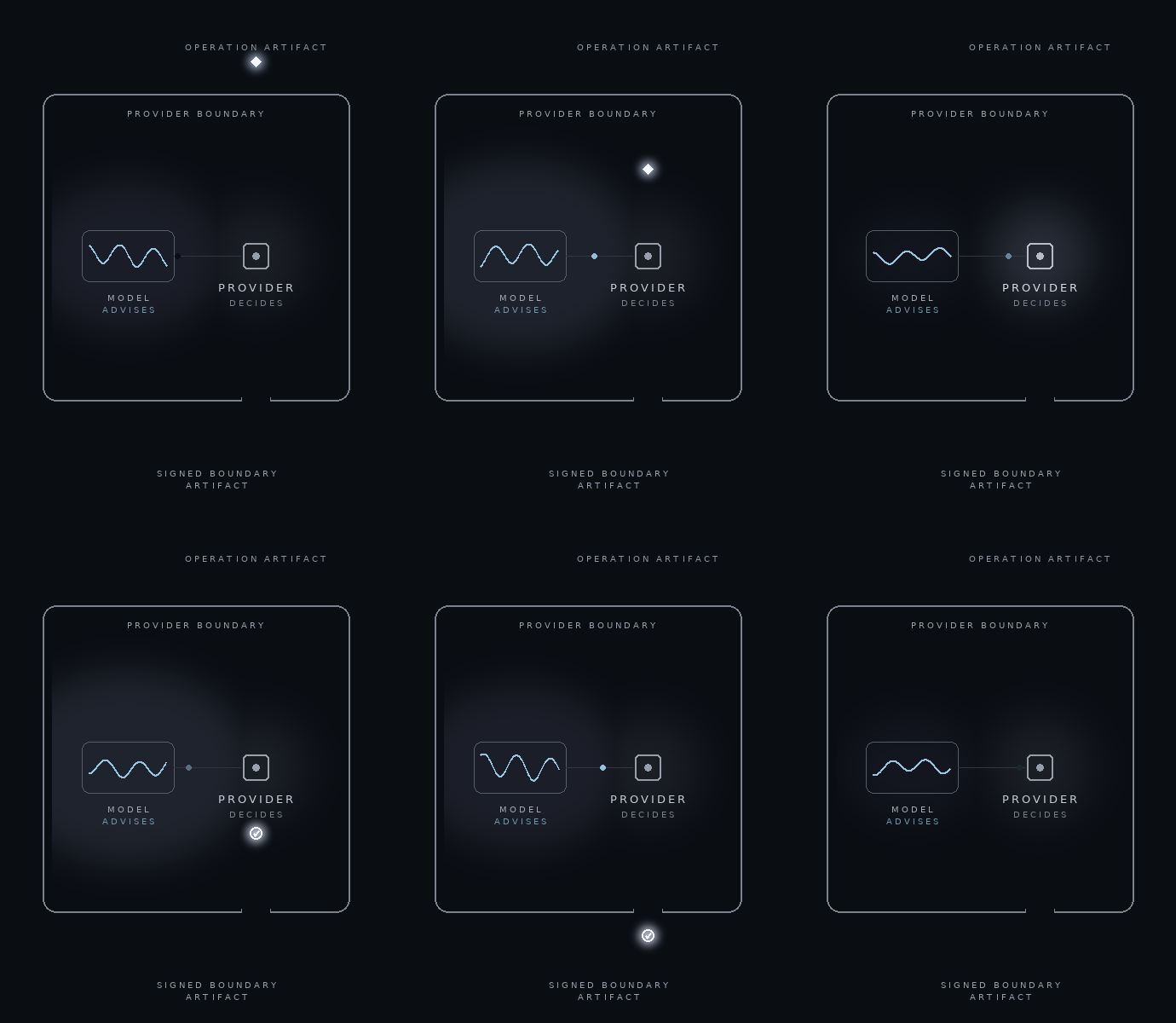
Scenario
An operation artifact originates outside a provider-controlled environment.
It may come from an agent, client, workflow, orchestration layer, broker, relay, queue, or other upstream system.
The artifact reaches a provider that must decide how, whether, and when execution proceeds.
Modern systems increasingly use adaptive logic to support that decision: models, risk scores, heuristic evaluators, policy-informed checks, contextual signals, or machine-assisted review.
PCADEB does not reject those mechanisms.
It constrains their authority.
Adaptive evaluation may be used inside the provider boundary. The model may inform the decision, but it does not become the decision authority.
The provider evaluates the artifact, determines the execution boundary condition, and generates or signs the boundary artifact.
What It Is
PCADEB is a provider-controlled framework for adaptive determination of execution boundaries.
It allows externally originated operation artifacts to be evaluated inside the provider environment using adaptive, model-driven, inference-based, learning-based, heuristic, or policy-informed mechanisms.
Those mechanisms operate as provider-controlled evaluative components.
They do not independently authorize execution.
The provider determines the execution boundary conditions.
The provider generates or cryptographically signs boundary artifacts representing execution milestones.
Those milestones may include initiation, progression, suspension, completion, termination, or other provider-defined execution states.
The important separation is not whether adaptive logic exists.
The important separation is where authority resides.
How It Differs
External AI policy engines, risk-scoring systems, adaptive access-control services, and shared authorization layers often evaluate requests outside the provider boundary.
They may produce a decision, score, label, or policy result that downstream systems treat as authoritative.
PCADEB is different.
PCADEB does not move provider execution authority into an external model, shared policy layer, intermediary, or orchestration service.
It does not require external systems to understand provider-internal evaluation semantics.
It does not expose provider decision models, adaptive parameters, rationale, policy logic, or execution semantics.
The adaptive system may advise.
The provider decides.
Under Compromise
A compromised intermediary, relay, broker, scoring service, or upstream component may interfere with availability or artifact handling.
It may drop, delay, duplicate, reorder, replay, alter, or withhold artifacts depending on the surrounding implementation.
It may attempt to supply misleading context.
It may attempt to influence what reaches the provider.
It cannot determine provider execution boundaries merely by participating in the path.
It cannot convert a score, model output, policy label, or transported artifact into provider authorization.
It cannot generate valid provider boundary artifacts unless the provider generates or signs them.
It cannot make execution valid unless the provider evaluates the artifact and determines the execution boundary condition.
How It Works
PCADEB keeps adaptive evaluation inside the provider-controlled environment.
An externally originated operation artifact is received by the provider.
The provider evaluates the artifact using provider-controlled adaptive mechanisms.
The evaluation may consider the artifact, provider-side context, execution-related events, and state transitions inside the provider environment.
Based on that evaluation, the provider determines one or more execution boundary conditions.
The provider then generates or cryptographically signs boundary artifacts representing the relevant execution milestones.
Those boundary artifacts may be exposed, transmitted, logged, anchored, or observed externally.
External observability does not transfer authority.
The path may see the boundary artifact.
The provider defines what it means.
What to Measure
In a provider-first implementation, the useful measurement is not whether an adaptive system produced a score.
It is whether the score became authority.
The relevant questions are:
- Did an external model, policy service, intermediary, or orchestration layer determine execution behavior?
- Did a score, label, model output, or risk classification become authorization?
- Did an external evaluator create or imply a provider execution boundary?
- Did a system outside the provider gain access to internal decision logic, adaptive parameters, rationale, or execution semantics?
- Did a provider-rejected request cause execution, data access, or provider-side effects before the provider determined the boundary?
PCADEB reframes adaptive evaluation around authority placement.
The question is not whether boundary evaluation can adapt.
The question is whether the provider remained the only authority that could determine the boundary.
What It Doesn't Do
PCADEB does not make an external AI system the execution authority.
It does not turn a model score into provider authorization.
It does not prevent the provider from using adaptive, model-assisted, heuristic, inference-based, or learning-based mechanisms.
It does not require adaptive evaluation to occur outside the provider.
It does not expose provider-internal decision models, policies, adaptive parameters, rationale, or execution semantics.
It does not require shared enforcement logic.
It does not replace provider-side security.
It does not require static rule-based policy evaluation.
It constrains where adaptive mechanisms operate and what authority they can acquire.
Where It Fits
PCADEB is one of eleven modules in the Xer0trust boundary architecture.
These modules are designed prevent routing infrastructure, brokers, intermediaries, hubs, adaptive systems, or shared control planes from acquiring execution authority merely because they participate in the request path.
The model may advise.
The provider decides.